"Two women can hear the same three words — you have breast cancer — and still need two completely different plans. The difference is not how hard we treat, but how precisely we choose." — Jiahui International Cancer Center
SHANGHAI — Breast cancer is not one disease. Under a single name sit several biologically distinct tumours that grow at different speeds, respond to different drugs, and call for different operations. That is why the question patients ask most often — "what is the standard treatment?" — rarely has a single answer.
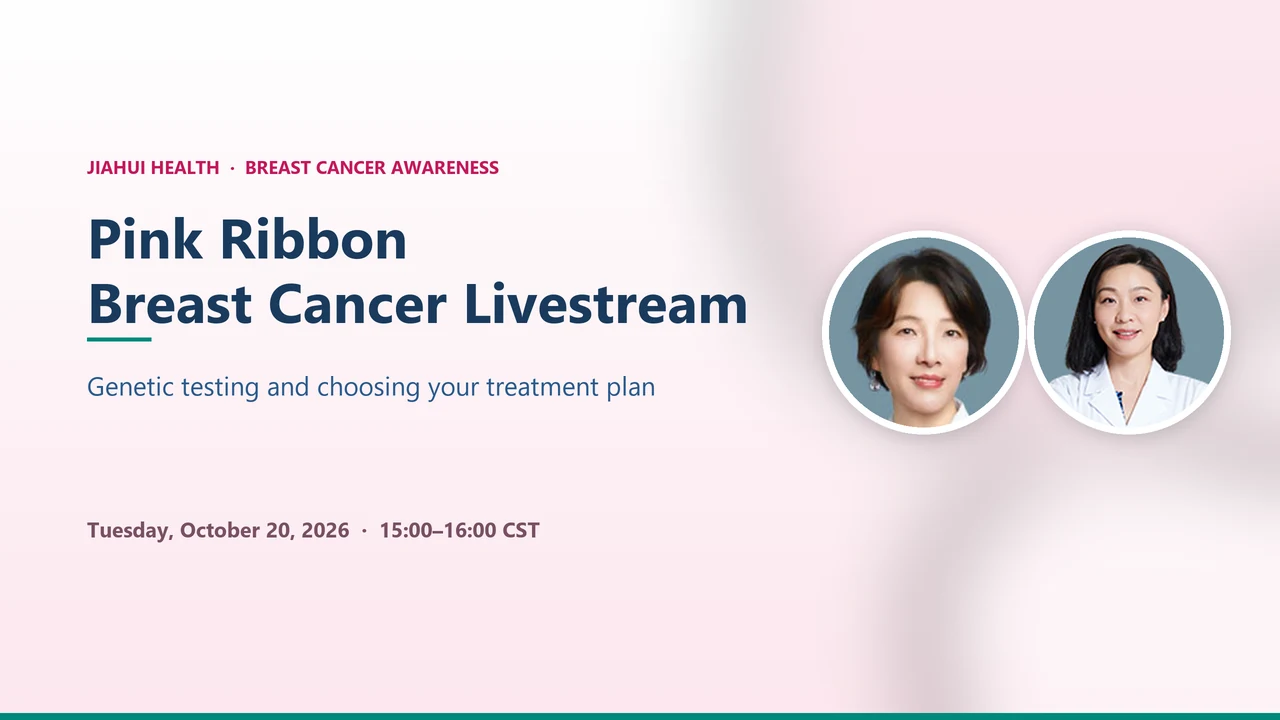
For Breast Cancer Awareness Month, Jiahui Health is hosting a free public livestream on Tuesday, October 20, 2026, from 15:00 to 16:00 (China Standard Time), together with the patient community platform Mijian (觅健). Two Jiahui directors will take the questions patients actually arrive with: Dr. Xuan Linli, Director of Medical Oncology at the Jiahui International Cancer Center, and Dr. Wang Zhengyuan, Deputy Director of the Jiahui Breast Clinic.
The session is built around four questions:
- Why do two patients with the same diagnosis receive different treatment plans?
- Does every woman with breast cancer need chemotherapy?
- What can genetic and molecular testing tell me about my options?
- Which operation actually fits my tumour, my body and my life?
How to Join
The livestream is open to the public and free of charge. Registration is through Jiahui Health's official WeChat account; the session is conducted in Chinese. A dedicated 15-minute Q&A closes the programme, with questions collected from the live comment stream.
Viewers who watch for at least ten minutes are eligible for the event draw, which includes a radiotherapy consultation fee-waiver voucher and a breast health screening voucher (ultrasound or mammography, one of the two).
Why the Same Diagnosis Leads to Different Plans
Before any drug is chosen, a tumour is characterised. Pathologists establish the hormone receptor status (oestrogen and progesterone receptors) and HER2 status, and measure the proliferation marker Ki-67. These three results already sort breast cancer into groups that behave very differently: hormone receptor-positive, HER2-positive, and triple-negative.
Around that core, oncologists weigh stage and nodal involvement, menopausal status, general health and other conditions, the patient's age and family plans, and — increasingly — the genomic risk score of the tumour itself. A genomic assay run on the surgical specimen can, in the right patient, show that chemotherapy would add little; in another patient with a similar-looking tumour, it points the other way.
This is what "precision" means in practice. It is not a more expensive version of the same plan. It is a different plan, chosen because the biology is different.
What Genetic Testing Actually Tells You
Patients often use "genetic testing" to mean two different tests, and the distinction matters.
Germline testing looks at inherited genes — BRCA1 and BRCA2 above all, and also PALB2, TP53, PTEN and CHEK2. A pathogenic variant here is information about the person, not only the tumour. It changes the conversation in three directions: it may make risk-reducing surgery on the opposite breast a reasonable option; it triggers screening for relatives who may carry the same variant; and in HER2-negative metastatic disease it can open the door to PARP inhibitor therapy. Testing is not offered to everyone — referral usually follows age at diagnosis, family history, triple-negative disease, male breast cancer, or certain ancestry patterns.
Tumour (somatic) profiling looks at the changes inside the cancer cells themselves. It is what identifies PIK3CA mutations that make a tumour eligible for targeted therapy, ESR1 mutations that explain resistance to endocrine treatment, and rarer targets such as NTRK fusions or MSI-high status. It also determines whether a tumour is "HER2-low", a category that has changed treatment sequencing in recent years.
Choosing the Operation: What Actually Drives the Decision
Surgery is where patients feel the stakes most personally, and where the honest answer is that more extensive is not automatically better.
Breast-conserving surgery followed by radiotherapy is oncologically equivalent to mastectomy for many early tumours, provided the tumour can be removed with a clear margin and the breast can still be treated with radiation to an acceptable dose. Mastectomy becomes the better choice when the disease is multicentric, when the tumour is large relative to breast volume, when radiation has already been given to that side, or when the patient prefers it after a full discussion of what surveillance will involve.
The axilla is managed separately. Sentinel lymph node biopsy has replaced routine full clearance for clinically node-negative disease, sparing many women the long-term risk of lymphoedema. Oncoplastic techniques allow larger resections to be closed with a good cosmetic result, and for women who need mastectomy, skin- or nipple-sparing mastectomy with immediate reconstruction can be performed in selected cases.
Genetic status feeds directly into this conversation. A confirmed BRCA1 or BRCA2 variant, for instance, makes contralateral risk-reducing mastectomy a legitimate option to discuss — not a recommendation that applies to everyone.
About the Speakers
Dr. Xuan Linli, MD is Director of Medical Oncology at the Jiahui International Cancer Center. She has worked in cancer research and clinical care for more than 30 years. After six years of study at Shanghai Medical College, she trained in haematology at Huashan Hospital, Fudan University, under Professor Ding Xunjie, one of the founders of the hospital's haematology department. She then completed six years of residency and fellowship training in medical oncology and haematology at University Hospitals of Case Western Reserve University in Cleveland, and practised clinical oncology in the United States for more than twenty years before joining Jiahui. Dr. Xuan holds ABIM board certification in internal medicine, medical oncology and haematology, and is a member of the American Society of Clinical Oncology (ASCO). She led the care of China's first foreign patient to receive solid-tumour CAR-T therapy, and has extensive experience in CAR-T treatment and post-infusion management for both haematological and solid tumours.
Dr. Wang Zhengyuan, MD is Deputy Director of the Jiahui Breast Clinic and a certified trainer for the European Society of Surgical Oncology (ESSO). With more than twenty years of clinical experience, she previously served as deputy chief physician of breast surgery at Yangpu Hospital affiliated with Tongji University, and trained at the Fudan University Shanghai Cancer Center and the breast centre of University Hospital Düsseldorf. Her practice covers sentinel lymph node biopsy, axillary dissection, mastectomy, breast-conserving surgery, oncoplastic surgery, skin- and nipple-sparing mastectomy with single-stage reconstruction, core needle biopsy and ductoscopy, as well as the outpatient follow-up of benign breast conditions.
If You Cannot Attend
International patients who cannot join a Chinese-language livestream can still have their case reviewed. Jiahui's international patient team arranges remote second opinions on existing imaging, pathology and genomic reports, with interpretation in English and other languages, and coordinates in-person visits when travel is the right next step.
To discuss your case — or to ask what testing would be appropriate before you travel — contact the MedTourChina coordination team.
This article is for general health education and does not constitute medical advice. Treatment decisions for breast cancer depend on individual pathology, stage, genetic results and personal circumstances, and should be made with your treating physicians.